Common, Chronic, and Largely Untreated
Few chronic conditions are as widespread — or as widely ignored — as hearing loss. Figures from the National Institute on Deafness and Other Communication Disorders (NIDCD) put the number of American adults who would benefit from hearing aids at roughly 28.8 million. But adoption tells a different story: fewer than one in three adults over 70, and fewer than one in six adults between 20 and 69, have ever worn one.
Lack of awareness alone does not explain that gap. Cost, lingering stigma, uneven access to audiology services, and the sheer slowness of the condition all play a part — when hearing fades gradually, it becomes surprisingly easy to rationalize or work around.
What Presbycusis Actually Is
Clinicians call age-related hearing loss presbycusis, and it is the most frequent form of sensorineural hearing loss there is. It typically progresses symmetrically in both ears and hits high frequencies hardest — precisely the range where consonants and much of the detail of speech live.
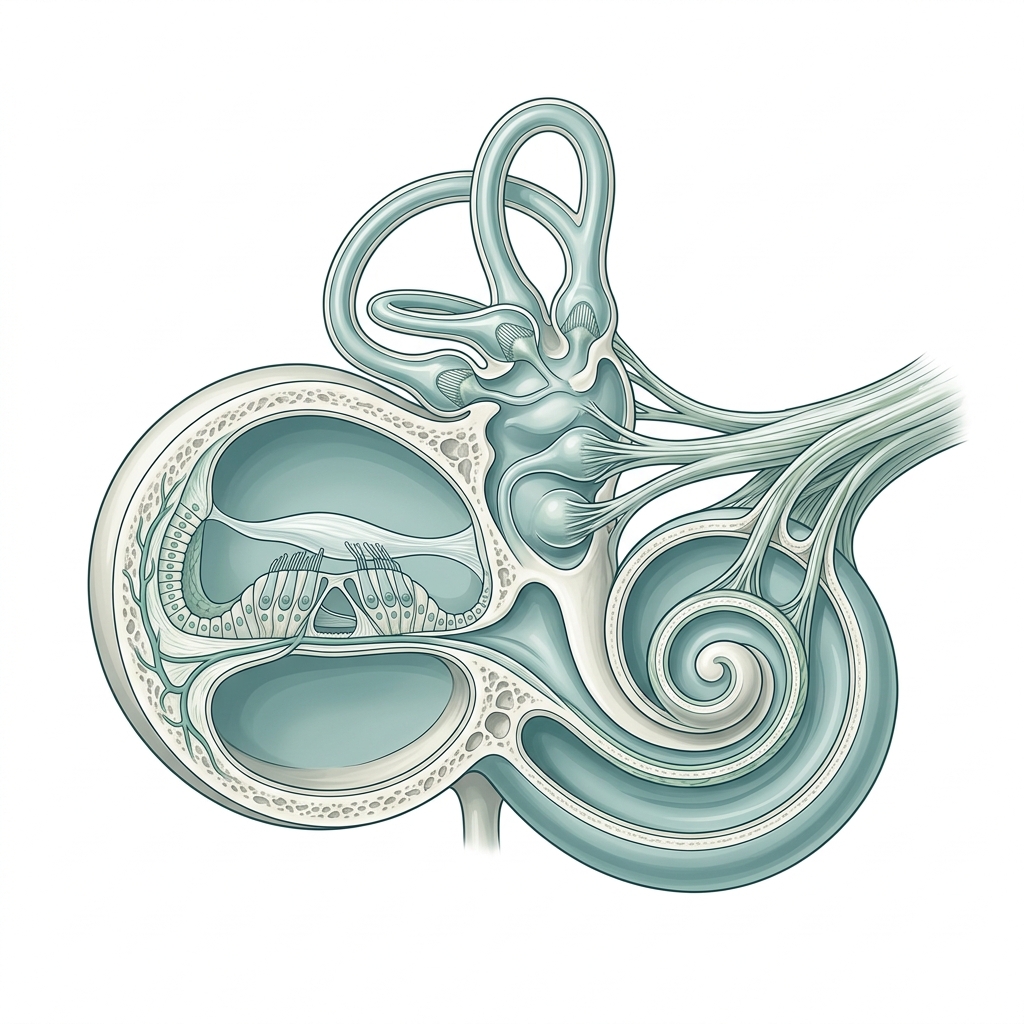
The story unfolds inside the cochlea, the fluid-filled spiral of the inner ear lined with thousands of microscopic hair cells. Those cells convert vibration into electrical signals that the auditory nerve carries to the brain. Decades of noise exposure, declining blood supply, changes in the stria vascularis (the tissue that keeps cochlear fluid chemically balanced), and ordinary cellular aging slowly kill these cells off.
Here is the crucial problem: in mammals, cochlear hair cells never grow back. Each person is born with about 15,000 per ear, and as the count falls, the window of audible sound narrows — usually so gradually that years can pass before anything feels wrong.

What the Studies Say About Cognition
For roughly twenty years, researchers have been probing a question that goes beyond communication: is hearing loss tangled up with broader changes in the brain?
The pivotal 2011 study by Frank Lin and colleagues at Johns Hopkins, published in Archives of Neurology, followed 639 older adults for almost twelve years. Participants who began the study with hearing loss were significantly more likely to develop dementia over the follow-up window — and the worse the hearing, the higher the risk. Mild hearing loss came with nearly double the dementia risk of normal hearing; severe loss came with five times the risk.
"Hearing loss is independently associated with accelerated cognitive decline and incident cognitive impairment in community-dwelling older adults."
Lin et al., JAMA Internal Medicine, 2013
A 2013 follow-up by the same group in JAMA Internal Medicine tracked 1,984 older adults for six years. Those with hearing loss showed cognitive decline running 30 to 40 percent faster than their normal-hearing peers — even after accounting for age, diabetes, and hypertension.
Then in 2014, Gurgel and colleagues at the University of Utah reached a compatible conclusion in a large population-based cohort: people diagnosed with hearing loss received dementia diagnoses at a significantly higher rate across ten years of follow-up.
None of this proves causation — the studies establish association. But researchers have sketched plausible mechanisms. The "cognitive load" hypothesis holds that a brain working overtime to decode garbled sound simply has less capacity left for memory and thinking. Another explanation leans on isolation: strained conversation pushes people away from social life, itself a well-documented risk factor for decline. A third possibility is a shared underlying disease process damaging both hearing and cognition at once.
The 2020 Lancet Commission on dementia prevention went as far as ranking hearing loss as the largest modifiable dementia risk factor of all, estimating that addressing it could prevent up to 8 percent of dementia cases globally.
The Social and Emotional Weight of It
The consequences reach well beyond cognition. Struggling to follow conversation — especially in loud restaurants, at family gatherings, or across a workplace — breeds frustration, fatigue, and a quiet retreat from social life.

Work in the Journal of the American Geriatrics Society bears this out: older adults with hearing loss report more loneliness, more depression, and lower quality of life than peers with intact hearing. The strain spreads to spouses and family, who find themselves repeating sentences, raising the television volume, and relaying conversations on the listener's behalf.
The emotional side is easy to miss. People with gradual loss often say they feel "left out" rather than deaf. What disappears first are the subtleties speech carries — humor, irony, emphasis — and with them goes a quiet but persistent thread of connection.
Why Price Kept People Away
For decades, cost stood squarely between patients and treatment. A 2015 report by the President's Council of Advisors on Science and Technology (PCAST) put the average price of a pair of prescription hearing aids near $4,672, with some clinics charging past $6,000. Traditional Medicare offered no hearing aid benefit, and private plans frequently covered little or nothing.
That sticker price bundled more than hardware — it wrapped in the evaluation, fitting, adjustments, and follow-up care. Defenders of the model pointed to the professional oversight it guaranteed; critics countered that the packaging priced millions of people out of treatment entirely.
Enter the OTC Rule
Everything shifted in August 2022, when the FDA finalized its rule creating an over-the-counter (OTC) category for hearing aids. Effective that October, adults 18 and older with perceived mild to moderate loss can now buy certain devices straight from retailers or online — no medical exam, no audiological workup, no professional fitting required.
The rule was a long time coming. Its roots trace to the Over-the-Counter Hearing Aid Act of 2017, a bipartisan measure folded into the FDA Reauthorization Act that instructed the agency to define standards for a prescription-free class of devices.
Supporters predicted the change would spark competition, pull prices down, and open the market to the millions who had stayed away for financial reasons. Early signs agree: new devices have launched well below traditional prescription pricing, with some pairs selling for under $1,000.

How to Shop for a Hearing Aid
Whichever route a buyer takes — OTC or prescription — hearing care professionals tend to point to the same handful of considerations before any purchase.
Severity and Pattern of Loss
OTC devices are built for mild to moderate loss. Severe or profound loss, loss that affects only one ear, or loss that appeared suddenly all warrant a professional evaluation, since these patterns can signal medical conditions needing attention.
Sound Processing
Today's aids amplify selectively through digital signal processing. Worth comparing: directional microphones (helping speech stand out in noise), feedback cancellation, noise reduction, and how many adjustable frequency channels the device offers.
Fit and Comfort
An uncomfortable hearing aid ends up in a drawer. Prescription models are molded to the ear by an audiologist; OTC models ship with assorted ear tips and leave the fit to the user. How a device feels after a full day of wear matters as much as how it sounds.
Trials and Returns
Reputable sellers on both sides of the market offer return windows. That protection matters: adapting to amplified sound takes weeks, so a device that feels wrong on day one may settle in later — or never.
Getting a Baseline
Even in the OTC era, a baseline audiogram from a licensed audiologist has value. It maps the type, degree, and shape of the loss, which sharpens device selection and keeps expectations realistic.
Where the Field Is Heading
A few threads of research and technology could reshape this landscape over the next decade.
The ACHIEVE study (Aging and Cognitive Health Evaluation in Elders) — a large randomized controlled trial run across multiple U.S. sites — set out to test whether treating hearing loss can slow cognitive decline in older adults. Its published results added meaningful evidence on how hearing intervention relates to cognitive outcomes, especially among people already at elevated risk.
Hair cell regeneration research also marches on. Several teams and biotech firms are exploring compounds and gene therapies that might coax mammalian cochlear hair cells to regrow — an ability birds and fish have but humans were long believed to lack. Clinical use remains years out, though early-stage work has shown hints of promise.
On the device side, manufacturers keep refining signal processing, wireless features, and miniaturization. Smartphone pairing, live translation, and machine learning that adapts to a listener's surroundings are all active frontiers.
And maybe most consequentially, hearing health is shedding its stigma as the science around untreated loss grows harder to ignore. The argument for early evaluation and treatment has never been stronger.